Tuesday, July 30, 2013

Curl up and Die


Sometime a person just wants to curl up and die, like this katydid that drew its last breath on my bedroom floor.


That’s how I felt when I awoke from surgery eight weeks ago to find my left arm paralyzed. I wanted to curl up and die. When the surgeon told me the nerve might heal in six to eight weeks I thought my inner strength would not be sufficient to meet such an ordeal. During a later visit he told me that nerves heal much more slowly than other body parts, about an inch a month. He said the musculocutaneous nerve had been stretched. That’s the nerve on the distal side of the elbow. At an inch per month, it would take 16 months for the feeling to return to my index finger tip.

Now, eight weeks later, I still cannot raise my forearm. This morning a neurologist tested the nerves to my arm. This involved sticking needles in muscles as well as giving them electrical shocks. I’ve been getting acupuncture treatments, so this test was no biggie.

Then, bad news: the injured nerve is the brachial plexus, between my neck and shoulder, much higher than the musculocutaneous nerve. I figure that adds 14 or more months to nerve recovery. I might not live that long.

Knowing what I’m up against is a good thing. These past weeks I’ve lived in miserable uncertainty. Now that I know, I’m getting pissed off about it.

Getting pissed off is a good thing; it puts the fight back in me. Twenty-six years ago a rheumatologist told me I could only get worse and would end up in a wheelchair. That made me mad at him and I was determined to prove him wrong. I still don't even use even a cane or walker, so there!

How I would love to disprove the inch-a-month theorem. How I’d love to show ‘em what a determined woman can do. This isn’t the time to curl up and die.

Copyright 2013 by Shirley Domer

Friday, July 26, 2013

Strange July


This July has been passing strange. First of all, my left arm is still partially paralyzed following shoulder surgery on June 5 and I can’t do diddly-squat with it. Nerves, they tell me, take a long, long time to heal. It seems like eons, but I’ve seen a little improvement and am alternately optimistic and in despair.

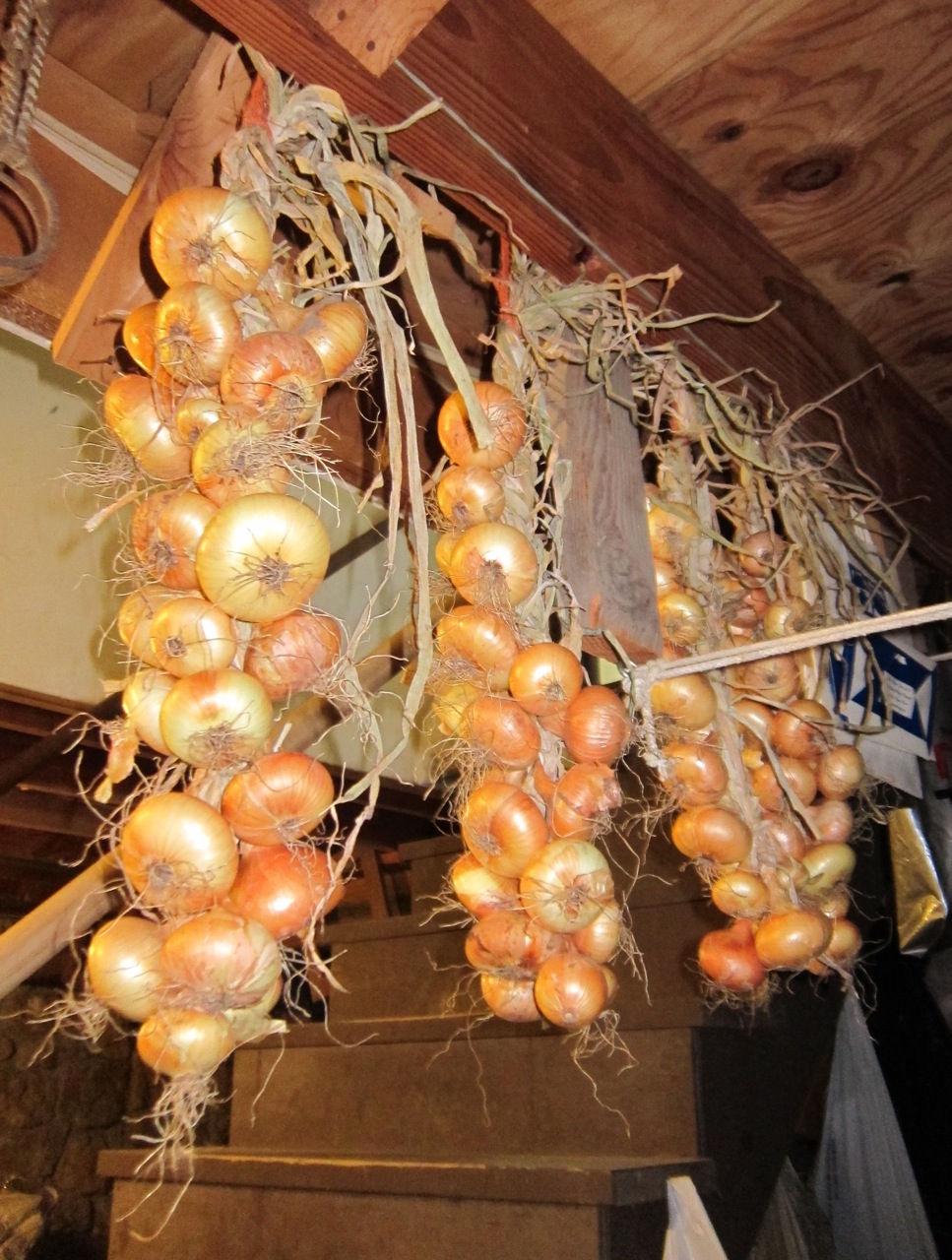
Luckily, I have a stand-in. Once a week or so Pam comes to do what I can’t. I stood by her side while she braided the unusually good onion crop, which now hangs at the foot of the basement stairs, ready to be plucked as needed.


Pam also laid out the shallot crop to cure. The shallots are another strange July phenomenon. They are the largest we’ve ever grown, but for the first time ever our tomato plants are sickly and not productive.


This July the weather has been strange, too. It isn’t hot. Today’s temperature is only 83ยบ! Six days ago 1.8” of rain fell! More is predicted.  Can this be July in eastern Kansas?
Here’s another strange thing: overnight, insects stripped every leaf from the sweet autumn clematis I’ve trained for two years to grow on the deck, looking forward to smelling its sweet perfume on cool September nights.

Here’s one of the culprits, a blister beetle.

Finally, it's strange to have a large sunny area in the front yard where the old locust stood.  Seeing Pam standing by the stump made me realize how big the tree was and what a large shadow it cast.


Growing old one comes to expect certain things to follow familiar patterns. This July has proven that assumption wrong, but I do long for normalcy.


Copyright 2013 by Shirley Domer

Monday, July 22, 2013

From Shade Tree To Firewood


For thirty-seven years the venerable locust tree shaded our driveway. Sometime before we came here it had lost a large limb, leaving a cavity that held rainwater and bred mosquitoes if we didn’t remember to pour some oil on the water. Then last February under a heavy, wet snow another large, hollow limb succumbed, lodging against another tree and scattering smaller branches across the driveway.


When Steve came to clean the chimney in March he remarked that the old tree easily might lose another large limb, perhaps damaging a person or vehicle. “I could cut that tree for you after I retire from the sheriff’s department in July. I would cut it into firewood lengths, too, and stack it.” We quickly struck a deal.

Last week Steve and his son-in-law came with chain saws, ladders and ropes and quickly set about taking the tree down. Somehow a hackberry tree has managed to grow straight up through the locust’s branches. The locust is directly behind the hackberry in this photo. Steve is in the tree.


Within the hour they had dropped the tree exactly where they intended, to the northeast across the driveway. It fell without damaging any of the surrounding trees.


They set about trimming small branches and cutting the tree into sections.


By mid-afternoon the old locust was distributed into various piles, one of leafy branches, one of kindling-size lengths and several of firewood lengths, ready to be split when the weather turns cold.


The odd hackberry tree remains with its sixty-foot high trunk and a little topknot of leafy branches. Dennis quickly named it “The Giraffe.”

I predict that Steve will have a fine third career as a tree-cutter. Between our chimney and our dying pine trees, we will be seeing him often.
Copyright 2013 by Shirley Domer

Tuesday, July 16, 2013

The Best Medicine


Six weeks after shoulder surgery my left arm still has not recovered from nerve damage incurred during the operation. I still can’t raise my forearm, my  thumb and index finger are partially numb and my fingers won’t fully straighten.

I faithfully do the prescribed exercises and try to use my left hand to perform small tasks with my forearm supported in a sling. I’m able to move my arm a little now, but progress is going at a snail’s pace.

Dennis still has to prepare almost all of our meals, although he is ill-prepared for cooking. He does make good fried eggs, though, and sometimes serves them with biscuits he makes from scratch.


Ocassionally my patience wears thin and I cry in frustration when my hand can’t perform some little task. Just last evening after several failed attempts to insert a plug into its socket I howled with frustration and began to sob. Dennis gently put his arm around me and said, “Don’t worry, Shirley, we will get through this…if we don’t starve to death.”

We both burst out laughing. A good cry is fine to relieve stress, but a good laugh is the best medicine.

Copyright 2013 by Shirley Domer

Sunday, July 14, 2013

Cracks


Our average annual rainfall is a smidge over 37 ½  inches.  Only in May, June and September does the rainfall average an inch or more a week. That’s the amount of rainfall a vegetable garden needs.

In July and August we drag hoses around to water various sections of our garden. For example, here what the soil around one tomato plant in our garden looked like this morning. If we want tomatoes, we have to water.


Most of our spring and summer rainfall comes during thunderstorms. Thunder means lightning and lightning produces nitrogen, one of the elements necessary for plant growth. Watering with a hose adds nothing to the soil but some chemicals added to our rural water to make it potable. It just isn’t the same as natural rainfall.

Still, we’ve been watering our garden during July and August, sometimes June and September as well, for many years, resulting in huge water bills. Gradually our gardening habits have changed, though, and more and more we have spring and fall gardens. Except for tomatoes and peppers, we don’t plant vegetables that have to be watered through the hot, dry weather.

Today I asked Dennis to photograph the cracks in the garden soil because I can’t step outside without getting a dozen chigger bites. He returned to the house with the photo above and a new idea. He said, “Next year let’s put our tomatoes and peppers in giant pots on the patio? We would use less water and they would be easier to water.”

I wouldn’t want to put all my money on that approach, but it’s certainly worth an experiment. If our climate won’t adjust to our needs then I guess we must adjust our needs to our climate.

Copyright 2013 by Shirley Domer

Thursday, July 11, 2013

Onion Harvest


While I’m trying to recover from nerve damage incurred during my recent shoulder surgery my friend Pam comes to do many things I normally would do for myself. She bakes bread and prepares food, does laundry and anything else that needs doing. Today, among other chores, she harvested our onion crop. Here she is bringing one load into the snake room.*


This year’s onion bed had been enriched last fall with chicken house cleanings: straw and manure. The pay-off is a fine onion crop.


We cure the onions by spreading them on a wood pallet that permits air circulation. The pallet sits in the snake room where it is protected from direct sun. Both doors are open to keep fresh air circulating around the pallet. After a couple of weeks the onion tops will be dry and brown, but still flexible. That will be time to braid the onions and hang them in the basement for easy access and storage.

Now Pam is making pita bread, roasted red pepper hummus and tabouli salad. I’m grateful to have Pam, a smart, capable stand-in.

* The breezeway in our house is called the “snake room” because a rattlesnake came in while the room was under construction. The snake climbed the screen of the sliding door trying to get out. Kent, the contractor, dispatched it with a hoe. We believe our breezeway was a rattlesnake highway to winter hibernation in the rocky ledges below the house.

Copyright 2013 by Shirley Domer

Monday, July 8, 2013

Nest Robbers


Yesterday was Laurie’s day to collect the eggs laid by our jointly-owned hens, but to her dismay she found a black rat snake in the nest. She could see that it had just swallowed an egg. Her photo shows a swallowed egg as a light-colored lump just to the right of the snake’s head.


The snake was coiled around two more eggs, but Laurie left the snake and uneaten eggs, being unprepared to deal with either retrieving the eggs or getting rid of the snake.


By the time Dennis went to the chicken house three hours later, the snake had consumed all the eggs and was feeling lively. As Dennis approached the nest with weapon in hand, the four-foot-long snake slithered from the nest and raced out the door.

Dennis vowed to catch the evil-doer but didn’t expect to see it again soon. After all, adult snakes are supposed to eat about once a week. But today when he went to gather the eggs, there was a black snake in the nest, stuffed with eggs. This one Dennis quickly dispatched to meet its ancestors, using a few good whacks with an oak garden stake. He claims there was no reasoning with the serpent.

It looks like we have a black snake epidemic. Knowing my good man, I’d say those snakes better git while the gittin’s good.

Photos courtesy of Laurie Comstock.
Copyright 2013 by Shirley Domer