Saturday, December 29, 2012

Beach Walk


Hurricane Ike hit Galveston Island in September 2008 with 110 miles per hour winds and a 22-foot storm surge. The city, situated on the east end of the island, was inundated by six feet of water. On the west end, where countless vacation homes are located, beachfront homes were destroyed and the dunes swept away.

I was here two years later and found my favorite beach at the far west end of the island completely bare. Today I was amazed and delighted to find much of the formerly empty sand now well stabilized by plant growth. Plant life is essential to dune stabilization and preservation of the fragile shoreline, so this is very good news.


These salt-tolerant plants use marvelous tactics to achieve colonization. In the foreground above it’s clear how some of the plants spread over a wide area, snaking out in all directions. Here’s another one with a Christmas color scheme, bearing buds that soon will open into flowers.


The tide was out, leaving many sand-dwelling creatures stranded. I couldn’t see them, as they were buried, but I could see evidence of their homes. Thousands of them dotted the shoreline.

Some were indicated by holes.


Some were indicated by volcano-like rises.


And, finally, there was a feather, surrounded by tiny bird tracks. (To see the bird tracks clearly, double-click the image.)


The wind blew fiercely, as it often does on the shore, but I found the walk exhilarating and reassuring. It’s good to be back.

Copyright 2012 by Shirley Domer

Friday, December 28, 2012

Lunch Time on The Beach


On the beach today I came upon a group of sanderlings and little sandpipers looking for lunch as each wave left the shore. They eat tiny invertebrates buried in the sand.


The sanderlings, in the background, stalk along the shore with dignity, but the little sandpipers, in the foreground, run, stiff-legged, so fast their little legs are a blur. Dennis has always called them “race cars.” They always bring a smile.

Copyright 2012 by Shirley Domer

Thursday, December 27, 2012

Watching Weather and Counting Coots


A “blue norther” blew us into Texas, all the way to the Gulf Coast. It started in Kansas, trailed us through Oklahoma, where we missed a major ice and snow storm by a few hours, whacked us with a two-hour thunderstorm in Burlson, Texas, followed us to Austin, where the temperature rapidly dropped 40 degrees, and all the way to the house we’re renting on Galveston Island, Canal Breeze. This is the same major storm that has dumped snow, stranded travelers and spawned tornados over the last two days.

Blue northers are usually followed by blue skies, but today is heavily overcast with a strong wind out of the east. What’s more, a fierce little arc of cold is racing southeast from Washington and Oregon and will complete its trip to the Gulf in less than 24 hours. Rain is coming tonight and tomorrow.

That’s just fine with me. I need to rest up from the long drive, put my belongings in order and settle in for a two-month stay. Day after tomorrow will be warm and sunny and I’ll be ready to walk the beach.

In the meantime, I am entranced by the birds I can see from our deck. In the bay, just half a block away white ibis, gulls and herons are looking for lunch in the mud exposed by low tide. Canal Breeze is bounded on two sides by canals where three coots were swimming this morning. I think there were three coots, but there may have been four. Counting coots is uncertain because they dive often and pop back to the surface in unexpected places, often twenty feet from where they went down. This little band of coots was moving as a group toward the canal’s outlet and has now joined others in the bay, but they – or their kin – will return.

From our deck we look at a row of canal houses, most shuttered and silent. Palm fronds rattling in the wind and an occasional squack from a sharp-tailed grackle are the only sounds.


Running through my mind is that song from the musical, Annie, “I Think I’m Gonna Like It Here.”

Copyright 2012 by Shirley Domer

Friday, December 21, 2012

December 21


We have lots to worry about today – the fiscal cliff, the Mayan end-of-world “prediction,” and whether we can make it through the holidays without having nervous breakdowns, to name just three.

I’m not going to worry about those things. I’m just happy that the shortest day of the year has finally arrived and that day length will start growing instead of shrinking.

Some primitive people weren’t so sure that would happen. They worried that the sun would disappear altogether and performed ritual ceremonies to ensure that didn’t happen. After they figured out the solstice they celebrated its arrival with food, drink and revelry. When Christianity came along it was easy to switch to Christmas parties and gift-giving, perhaps to excess. Instead I prefer to celebrate a little bit each day.

Today’s celebration for me was making granola. My palate having already wearied of buttery, sweet holiday treats, I longed for something more nourishing. Honestly, I enjoy a bowl of granola far more than a piece of English toffee.


Out of necessity I accidentally improved my granola recipe, which calls for half a cup of honey. I had only a quarter-cup of honey so I added a quarter-cup of Steen’s cane syrup, a product of the South.


Cane syrup is not widely available or even known outside the South. Sugar cane is a perennial grass that grows only in tropical or semi-tropical places. Dennis and I once drove into New Orleans along a minor highway that led through sugar cane country. It was harvest time and we often came upon tractors pulling wagonloads of cut cane to the mill. We could see the smoke rising from a mill in the distance and the air was full of the fragrance of cane as it cooked down into syrup. Shopping later in a grocery store I spotted cane syrup and bought some to try on pancakes and biscuits. I’ve been a cane syrup fan ever since.

The first batch of granola was so good that I made another batch substituting cane syrup for all of the honey. It’s a winner!

Granola

8 cups old-fashioned oats
1 cup sliced almonds or other nuts
½ cup packed light brown sugar
½ teaspoon salt
1 teaspoon ground cinnamon
½ cup vegetable oil
½ cup honey or cane syrup
1 teaspoon vanilla
1½ cups raisins or dried cranberries

Preheat oven to 300 F. In a bowl mix the oats, almonds, brown sugar, salt and cinnamon. In a microwave warm the oil and honey. Whisk in vanilla.

Carefully pour the liquid over the oat mixture. Stir gently with a wooden spoon; finish mixing by hand. Spread granola in two 15” x 10” inch baking pan.

Bake 40 minutes, stirring carefully every 10 minutes. Transfer granola-filled pan to a rack to cool completely. Stir in raisins or cranberries. Seal granola in an airtight container or self-sealing plastic bag.


Now it’s time to quit cooking and finish packing. My next post will come from Galveston Island sometime after December 26.

Happy holidays, everyone. Don’t worry; be happy.

Copyright 2012 by Shirley Domer

Tuesday, December 18, 2012

How I Know Winter Is Coming

Winter officially will begin on Friday, but even if I didn't have a calendar I would have known it was coming because a box elder bug showed up on my desk this morning. The box elder bug is a smart one who knows when the time has come to seek a warm spot to wait for spring.


I intend to do that myself. Dennis and I will leave for Galveston Island this weekend and I won't be back until it's time to plant potatoes.

Saturday, December 15, 2012

English Toffee Step-By-Step

English toffee is sort of like a Heath candy bar only far, far better. It has four ingredients and does not require a candy thermometer. It’s all in technique. I made a batch today. First I melted butter in a heavy saucepan over medium low heat.


While the butter melted I assembled the other ingredients: sugar, slivered almonds and a few almonds finely chopped. Chocolate chips are not shown.


When the butter was completely melted I added the slivered almonds and sugar, turned the heat to high, set the timer to five minutes and started stirring rapidly. At first the butter remained liquid.


Soon, the butter and sugar began to congeal into a mass.


Now the mass started to pull away from the side and bottom of the pan.


The mass began to turn brown.


Shortly before the timer hit four minutes the bottom of the pan began to smoke. I was stirring like crazy. The almonds were making popping noises. 


Dennis quickly removed the pan from the heat and poured the hot mass into the 9”x13” pan that had been sitting on a back burner with barely warm heat under it. I spread the candy out as evenly as I could before it began to harden.


I sprinkled on chocolate chips. 


The chips become shiny instead of dull. Here just a few chips are still solid.


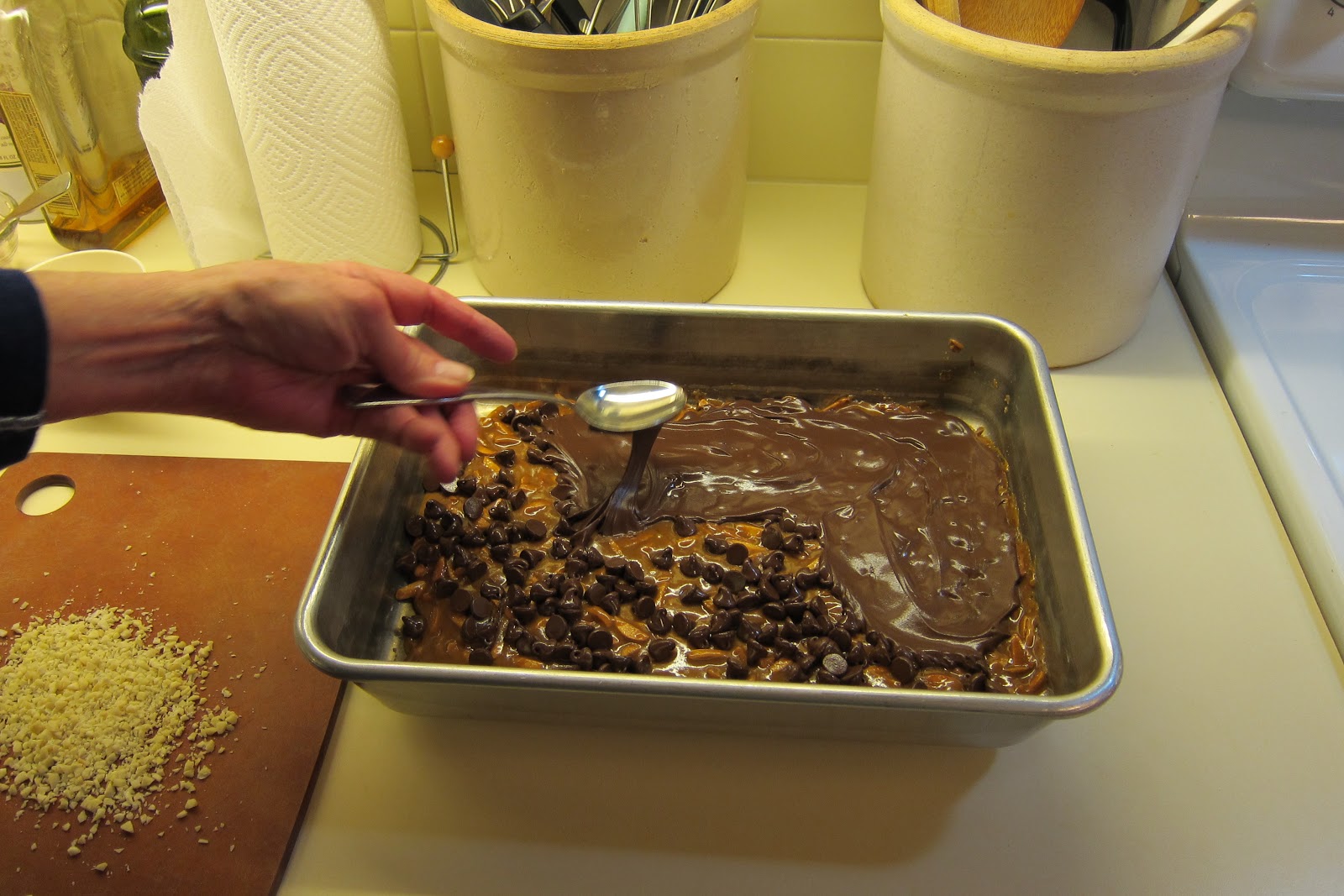
When all the chips were melted, I spread the chocolate over the toffee surface using the back of a soup spoon.

Finally, I sprinkled on the finely chopped almonds. They aren’t necessary but they add visual interest.

I will let the toffee sit overnight and turn it out of the pan tomorrow morning.

There’s a catch. Carol called to say that she made a batch this afternoon, too, but hers burned. She said the mixture began to brown as soon as she turned the heat to high. She uses a gas stove. I use an electric one. Maybe my pan is heavier than hers. Who knows, but if your toffee begins to brown as hers did, life the pan off the burner and turn down the heat! Also, the recipe says to cook the mixture about five minutes, but mine was done in a little less than four. Don’t be a slave to the instructions; trust your judgment.

English Toffee*
1 cup butter
1 cup slivered almonds
1¼ cups sugar
1 six-ounce package chocolate chips

Melt butter over low heat in a heavy 3-quart saucepan, then add nuts and sugar. Turn heat to high and stir rapidly until color changes to a light caramel, about 5 minutes. Almonds will start to make popping sounds at this stage and the mixture will have a compact appearance, yet be fluid enough to pour out. Do not overcook!

Remove from heat and pour at once into a slightly warm ungreased 13”x9” pan. Spread out as thinly and evenly as possible. Distribute chocolate chips over hot candy and spread evenly when they have melted. Sprinkle with a few finely-chopped almonds, if desired.

When the chocolate has completely cooled turn the pan upside down on waxed paper. Tap the pan to release the candy. Break in bite-size pieces.

Makes about 1¾ pounds.

*The recipe is in my 1970 copy of Farm Journal's Homemade Candy. I've been making it every December for 42 years.

Copyright 2012 by Shirley Domer


Thursday, December 13, 2012

Favorite Holiday Cookie


When the holiday shopping is done it’s time to start making holiday treats. First on my list is always Russian Tea Cakes, Dennis’ favorite cookie. Because this cookie is a type of shortbread that requires lots of butter, I make it only in December. If I made it all year ‘round, Dennis would get tubby. I made Russian Tea Cakes only yesterday. Today almost half of them have vanished, although he’s not entirely to blame for that. 

This cookie is not only delicious but also very easy to make if you have an electric mixer. A cookie scoop is helpful, too–the kind that looks like a miniature ice cream scoop.

The cookies don’t expand much, so they can be very close together. The entire recipe fits onto one of my cookie sheets. That's the cookie scoop beside the pan.


Russian Tea Cakes

Mix thoroughly...
            1 cup soft butter
            ½ cup powdered sugar
            1 teaspoon vanilla

Sift together and stir in...
            2¼ cups flour
            ¼ teaspoon salt

Mix in...
            ¾ cup finely chopped nuts

Using a cookie scoop, drop the dough onto an ungreased cookie sheet. (If you don’t have a scoop, roll the dough 1 teaspoonful  at a time into balls between your palms.)

Bake the cookies for 12 to 14 minutes at 375ยบ. The cookies should not brown, so keep an eye on them. Remove the cookies to a cooling rack.


Using a sugar shaker, dust them liberally with powdered sugar.


I always use pecans, but the cookies are good with almonds, too, especially if you add a bit of almond extract.

Next up: English Toffee.

Copyright 2012 by Shirley Domer