The answer to that question is "It all depends." If the seeds have sentimental value or heritage significance, such as my grandmother's larkspur, by all means save them. That said, it depends on how much money one is willing to spend on packets of seeds, attentiveness to detail and whether seed saving is fun or boring.
Just this morning I finished a harvest of 1/2 ounce of turnip seeds. A packet of 250 turnip seeds costs $3.89 ordered on line from GardenSeed.com. My harvest would make several packets at that rate. Less expensive seeds are available, particularly if purchased from a bulk vendor such as Roger, who owns Lawrence Feed and Farm Supply in Lawrence. Roger's turnip seed costs $1.95 for half an ounce, so that's what I've saved today.

For me, economy is not a sufficient reason to save seeds. For others, it may be. Only your pocketbook knows.
As for attentiveness to detail, that's my curse in life. I've always focused on detail and patterns. I notice the little things, often missing the big picture. Again, taking the turnip as example, last spring I noticed that a few turnip plants from the fall garden had survived the winter and started growing. I decided to leave a couple and see what happened. By April 6, the plants had started to bloom.

By April 27 the earliest tiny flowers had produced long seed pods while the plants continued to grow and put out new blooms.

As the seed pods matured they turned pale tan and dried. I noticed that the most mature ones had burst, dropping their contents to the ground. That told me I must harvest the pods when they were dry but before they popped open.
Yesterday I saw that both plants were totally dried up so I cut most of the branches and put them in a paper bag. After pounding on the bag for about 30 seconds, I lifted out the dried stems and burst pods, leaving seeds and small debris in the bag.
I put the stems and pods in our compost bucket.

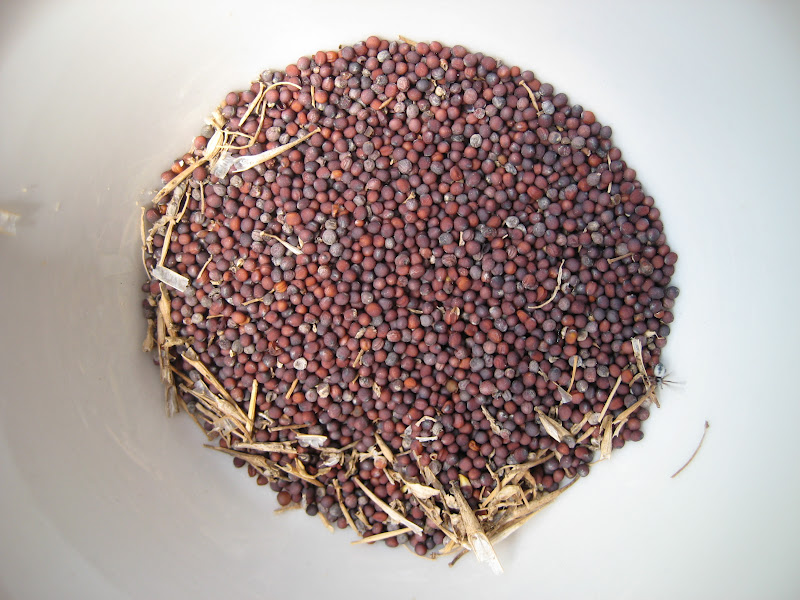
Then I spent a couple of minutes picking small debris out of the seeds, which I had poured into a custard cup. They are rather pretty, I think.

Hours of labor involved: 15 minutes at most. Time spent observing the plants' progress: 15 minutes over time. In the process I've learned a lot about turnips' growth cycle and behavior. It has been interesting.
So that brings me to the final "depends" element – fun. That's why I do it, for fun. It's fun to be outdoors, to observe the cycles of life and harmonize with them, and to stash seeds away for the fall garden. It may be silly, but no more so than watching television.
Just this morning I finished a harvest of 1/2 ounce of turnip seeds. A packet of 250 turnip seeds costs $3.89 ordered on line from GardenSeed.com. My harvest would make several packets at that rate. Less expensive seeds are available, particularly if purchased from a bulk vendor such as Roger, who owns Lawrence Feed and Farm Supply in Lawrence. Roger's turnip seed costs $1.95 for half an ounce, so that's what I've saved today.

For me, economy is not a sufficient reason to save seeds. For others, it may be. Only your pocketbook knows.
As for attentiveness to detail, that's my curse in life. I've always focused on detail and patterns. I notice the little things, often missing the big picture. Again, taking the turnip as example, last spring I noticed that a few turnip plants from the fall garden had survived the winter and started growing. I decided to leave a couple and see what happened. By April 6, the plants had started to bloom.

By April 27 the earliest tiny flowers had produced long seed pods while the plants continued to grow and put out new blooms.

As the seed pods matured they turned pale tan and dried. I noticed that the most mature ones had burst, dropping their contents to the ground. That told me I must harvest the pods when they were dry but before they popped open.
Yesterday I saw that both plants were totally dried up so I cut most of the branches and put them in a paper bag. After pounding on the bag for about 30 seconds, I lifted out the dried stems and burst pods, leaving seeds and small debris in the bag.
I put the stems and pods in our compost bucket.

Then I spent a couple of minutes picking small debris out of the seeds, which I had poured into a custard cup. They are rather pretty, I think.
Hours of labor involved: 15 minutes at most. Time spent observing the plants' progress: 15 minutes over time. In the process I've learned a lot about turnips' growth cycle and behavior. It has been interesting.
So that brings me to the final "depends" element – fun. That's why I do it, for fun. It's fun to be outdoors, to observe the cycles of life and harmonize with them, and to stash seeds away for the fall garden. It may be silly, but no more so than watching television.


