Wednesday, February 19, 2014

Being Old; Being Happy


My pal Barbara send me a link to a New York Times article, “What Makes Older People Happy?” The author cites several studies that show the difference between happiness in young people and happiness in older people. Basically, while youth find happiness in extraordinary experiences, older folk find it in familiar routines. I couldn’t agree more.

I’ve seen a lot in my lifetime and traveled to both Europe and Asia. I’ve gone camping in the mountains and visited countless museums. I’ve attended concerts and expositions. At this point in life I hope to never tour another damp cathedral or endure another corny opera.

Nope, my happiness lies in doing the most mundane of tasks. Currently baking whole wheat sourdough bread makes me very happy. When I sliced the bread for our breakfast this morning I was pleased to see that it soon will be time to bake another loaf.


Thinking about why bread baking makes me happy I realize that a lot of pleasure comes from my symbiotic relationship with my sourdough starter, or, as some in the sourdough trade call it, my “mother sour.” Starter consists of lactobacilli and wild yeasts., two life forms very different from me. I nourish them; they nourish me. We keep each other going. In this way it is like keeping chickens.

I love watching the bread dough slowly rise, observing the fermentation process as the starter transforms the wheat gluten, making it more digestible for me. The wheat feeds both of us.

I love the aroma of the bread as it nears perfection in the oven. I love the texture and consistency of each slice. I love the slight sourness its taste.

Successfully getting the starter going and working out the recipe and process for this bread gives me a sense of achievement, a boost to my self confidence. I'm thrilled that I've made it work. The whole miraculous process makes me happy. 

In the end, the simple life is the best life. You young ones, get out there and explore. Please send postcards. I’ll be here baking bread.

Copyright 2014 by Shirley Domer

Monday, February 17, 2014

Too Chicken


Chickens are tropical birds, having ancestral roots in Southeast Asia and India. Oddly enough, chickens tolerate cold temperatures quite well. This winter, with temperatures hovering around zero and sometimes as low as -12º F, our chickens have shown no ill effects. I’ve read that sometimes a chicken’s comb will get frost bite, but I think that is mostly true for roosters, which have very large combs. Our hens’ little combs show no signs of damage.

Chickens and snow are an entirely different matter. The girls are too chicken to take a single step onto snow. Recently they have had to confine their outdoor life to a slim path that Dennis shoveled to facilitate the daily task of closing and opening the chickens’ little door. Gradually, as the days warm, their little snow-less area is expanding. The girls are patient. They enjoy running around outdoors but they’re willing to stand patiently until the spring thaw expands their tiny world.


Incidentally, there were more than 24 billions chickens on earth in 2003.* That’s more than three chickens for every human being.


Copyright 2014 by Shirley Domer
Friday, February 14, 2014

In Search of the Perfect Emollient


A couple of days ago I drove through our snowy landscape...


to visit Homespun Hill Farm, where Debbie raises grass-fed beef and lambs.


I wasn’t there to buy meat, but rather to buy beef suet. Rendering lard and getting lard on my hands had convinced me that animal fat makes an excellent emollient for chapped hands. I even put some lard on my face, with equally good results. Was I nuts to be doing this? On the internet I found that many others were doing the same thing, but one source claimed that tallow rendered from grass-fed beef was an even better skin softener. Curious, I sought out a source for grass-fed beef and that led me to Homespun Hill Farm.

Back home I immediately started rendering some of the suet in a big pot in the oven set at 250º F. Within two hours the fat was rendered and ready to strain through a cloth-lined sieve.


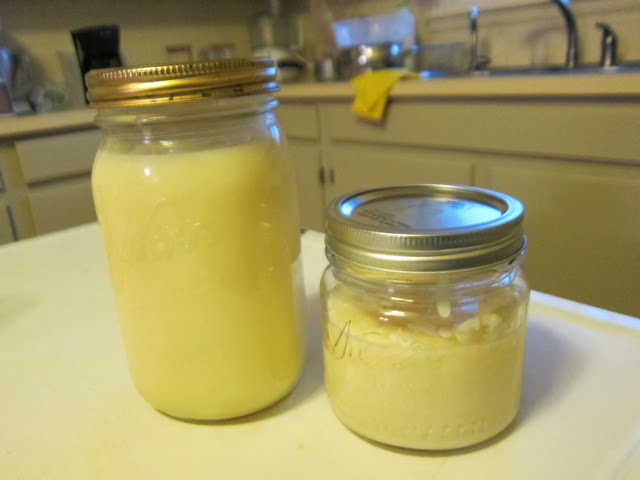
This resulted in almost one and a half quarts of tallow, enough to last a lifetime as skin softener.


The next morning I massaged a dab of tallow into my hands, cuticles, and face. Umm, very soft, indeed. Unfortunately I smelled like a French fried potato.

That’s all right. I’ll go back to lard for my emollient and use the tallow to make saddle soap.

Copyright 2014 by Shirley Domer

Monday, February 10, 2014

Brrr!


I’m beginning to get used to this winter weather. I don’t like it but I can tolerate it for a little longer.


Dennis the Intrepid has been my inspiration. Yesterday he set out for a walk in a snowstorm. The temperature was 13º F. He wasn’t gone for long before he returned. Ah, I thought, even Dennis can’t take it. I was wrong. He had come back to get his sunglasses to keep snowflakes out of his eyes. I see by his example that the only way to get past the weather is to ignore it and go about one’s business.

Today is bitterly cold again and grey. The house is festooned with icicles. Never mind. I’m making chicken soup and apple pie while Ray Charles serenades me. I’m determined to be happy with what I have – a warm house, plenty of food, and a good dog to keep me company. I'm a lucky woman.

Copyright 2014 by Shirley Domer

Saturday, February 8, 2014

So SAD


Last fall when Dennis was urging me to go south for the winter, as I have done many winters past, the idea didn’t appeal to me. For one thing, arthritis has now disabled me so much that I don’t feel comfortable living alone away from family and friends. For another thing, I had plans to do lots of creative work and wanted to be in my own work room with its sewing machine and  collections of thread, fabrics and a host of related tools and materials. I had visions of finishing a wall hanging started nearly two years ago and making one or two more, so I elected to spend the winter here in eastern Kansas.

I chose to be here during the worst winter in many years. We have had weeks of bitter cold and now lots of snow.


How much creative work have I done during this great opportunity? None whatsoever. Oh, I sewed a few things, all practical items. I’ve gotten so far as to lay out the wall hanging and the materials I need to finish it, but I can’t get started.

Instead of pursuing my objective I cook and eat and sleep and read a little. I experiment with making lard biscuits.


I bake bread. I exchange soup recipes with friends. (Curried cauliflower and sweet potato soup was delicious the first time, tasty the second time, and intolerable the third time.) I pace the house, going from one unfinished task to another. I feel guilty about having tricked ten Tiger’s Eye beans into germinating. They want so much to live and have no soil to nourish them.


I can’t even decide how to dispose of them. I'm both lethargic and restless. I’m on tenterhooks about everything.

This, I learned yesterday, is a pretty good description of seasonal affective disorder, with its appropriate acronym, SAD. I’m sad and I desperately want this winter to end. I long for the spiritual and physical revival that comes with the vernal equinox. How do the Russians, Scandinavians, and Alaskans keep their sanity during those long, long winters?

Copyright 2014 by Shirley Domer

Monday, February 3, 2014

Rendering Lard


This 13-pound bag of pork fat has been sitting in my freezer for three months, waiting for me to render it into lard. (I don't know why the label says $0.01. It really cost 40¢ a pound.) I’d never rendered fat before but I knew I would make a big mess doing it. Procrastination comes easily to me and I found several excuses, such as waiting until after the holidays or waiting until I had used up my supply of canola oil.

Finally, I knew it was time to wade into the fat. The butcher shop had ground the fat and I was thankful I didn’t have to chop hunks of fat into little pieces before I could begin. After the fat had thawed, which took a couple of days, I stuffed half the fat into the crock pot and turned the temperature to high.  Soon liquid began to form around the edges of the pot.


I stirred the fat every 20 minutes to keep it from sticking or burning. After a few hours a good amount of liquid fat had accumulated.


I set a cheesecloth-lined strainer over a large bowl and ladled some of the fat, both liquid and chunks, into it. 


Then I dumped the solids back into the crock pot. I repeated this process several times, each time pouring the liquid fat into a one-quart canning jar.


I was tired and wanting to go read my book by the time only a couple of inches of fat particles remained in the pot. I dumped the remaining fat into a large baking pan and put it in the oven to finish. The end result was another cup or two of liquid fat and a lot of cracklings. I drained the cracklings on a brown paper bag. We will sprinkle these crunchy, high-protein bits on salads.


Finally, I have two full quarts of lard and a small bowl full. 


Tonight I’m going to make lard biscuits for supper, just like my grandma used to do. And when I render the remainder of that big bag of fat, I’ll do it in the oven. To heck with the crock pot.

Copyright 2014 by Shirley Domer

Saturday, February 1, 2014

Tiger's Eye Beans


Four days ago I started some seed germination tests to determine whether seeds in my stash are still viable. I wrote about testing pepper, Chinese cabbage, and Abraham Lincoln tomato seeds, but didn’t mention the test I started on Tiger’s Eye beans.

Tiger’s Eye beans are a delicious heirloom variety that is grown only for dried beans because their shells are inedible. Cooked, the dried beans have tender skins and creamy interiors. They are called Tiger’s Eye because of their unusual markings.


The last time we grew Tiger’s Eye beans was 2009. Last week I cooked some with a ham shank, celery, and onion. This soup was so good that I vowed to plant Tiger’s Eye beans this year. I have enough left to plant a couple of rows, but doubted that the beans were viable because they have been sitting on my kitchen counter in a big canning jar for five years now.

A germination test was in order. I put ten beans on a wet paper towel and put the towel in a plastic sandwich bag. This morning I opened the towel to find that all ten of the beans germinated in less than four days.


Given a decent growing season, we will be harvesting Tiger’s Eye beans again next summer.

Copyright 2014 by Shirley Domer